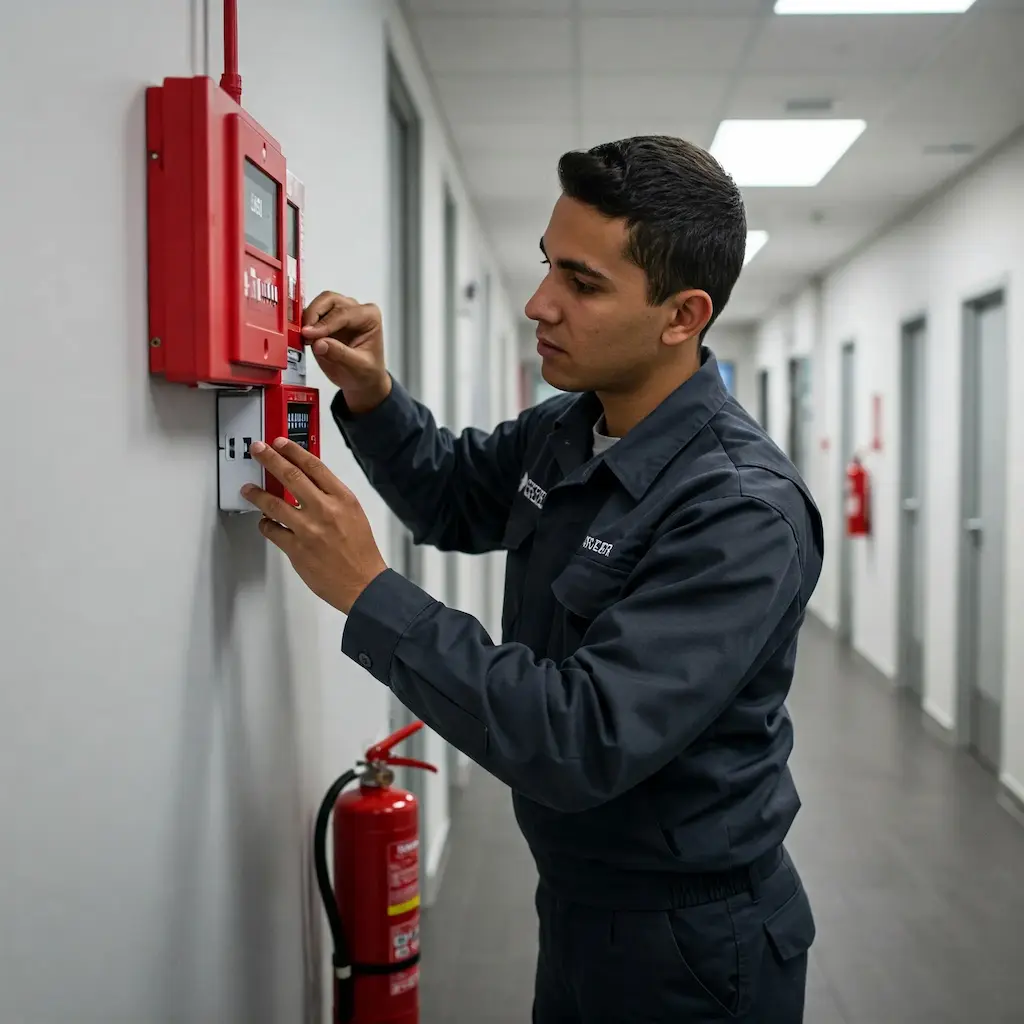
Avoid "Failure to Test" fines and False Alarm Fees. We provide annual NFPA 72 fire alarm testing, Regulation 4 & Title 19 compliance certification, affordable UL-listed 24/7 monitoring, trouble signal repair, and runner service for commercial and multi-family buildings across Los Angeles.
From annoying trouble signals to annual certification, we keep your building safe and silent.
Need an Annual Reg 4 Test or have a Trouble Signal beeping? We schedule quickly to silence the noise and ensure safety.
We test every pull station, smoke detector, and horn using NFPA 72 standards. We can also upgrade you to Wireless Monitoring to save money on phone lines.
We submit your Regulation 4 reports to Brycer and stick the Blue Sticker on your panel. You are compliant and protected 24/7.
Fill out the form for a free quote on Annual Testing, Monitoring, or Panel Repair. We respond within 24 hours.
Save money with 4G/5G Wireless Monitoring. No expensive copper phone lines needed.
Full testing of all devices: smokes, heats, pulls, and horns.
Emergency? Call us directly at (310) 945-2367
Your information is secure.
Unlike simple checks, Title 19 certification requires testing every single device. We test all detectors, pulls, and horns to ensure you are fully certified for the year.
Annoying beeping? Yellow trouble light? We are troubleshooting experts. Our trucks carry batteries and standard parts to fix ground faults and clear your panel immediately.
We handle the bureaucratic headache. Our team submits all official reports directly to The Compliance Engine (Brycer) ensuring the LAFD sees your compliance in real-time.
Annual fire alarm testing and NFPA 72 inspection, Regulation 4 and Title 19 certification, UL-listed monitoring, and trouble signal repair — handled for commercial and multi-family buildings across Los Angeles County.
The annual fire alarm system test is the full-performance test LAFD Chief's Regulation 4 requires each year. Technicians activate every initiating device — smoke detectors, heat detectors, and manual pull stations — and verify every notification appliance (horns, strobes, speakers) responds correctly. The fire alarm control panel (FACP) is tested for supervisory, alarm, and trouble signal processing, and the connection to the monitoring central station is confirmed end-to-end.
NFPA 72 is the national standard for fire alarm and signaling systems that LAFD inspectors reference. It sets the annual visual inspection and functional testing requirements for every component: initiating devices, notification appliances, the FACP, wiring and circuits, battery backup, and annunciator panels. Every test we perform is documented to NFPA 72 so the paperwork holds up at inspection.
Regulation 4 is LAFD's local rule requiring annual testing with results reported through The Compliance Engine (Brycer). Title 19 is the California state fire marshal's code that sets the technical testing standard. Both apply to commercial buildings in Los Angeles, and we certify under both in a single visit — test, document, file, and affix the compliance sticker on your panel.
Most commercial and multi-family buildings in Los Angeles are required to have 24/7 fire alarm monitoring so the fire department is automatically dispatched when an alarm activates. We provide UL-listed central station monitoring and can upgrade your building from an aging copper phone line to reliable wireless 4G/5G cellular monitoring — more dependable and typically cheaper than a dedicated phone line.
A beeping panel or yellow trouble light usually means a low battery, a ground fault (wiring issue), or a dirty smoke detector. Our technicians carry batteries, replacement detectors, and diagnostic equipment to resolve trouble signals in one visit. We clear the panel, document the repair, and if the issue stems from aging wiring or a failing FACP, provide a transparent quote for the next step.
All testing and repair services are expertly performed by our strategic service partner, Ace Fire LA. Together, we ensure your building meets all LAFD Chief's Regulation 4 standards with the highest level of technical precision and local expertise.
We've partnered with Ace Fire LA to provide our clients with the most reliable fire alarm technicians in Southern California. By combining our streamlined scheduling and filing systems with their decades of technical field experience, you get the fastest path to compliance in Los Angeles.
Answer: In Los Angeles, your fire alarm system requires a comprehensive Annual Regulation 4 Test. This includes testing every smoke detector, pull station, and horn/strobe to ensure it functions during an emergency.
Answer: A beeping panel usually indicates a "Trouble" signal. This could be a low battery, a ground fault (wiring issue), or a dirty smoke detector. We can diagnose and silence these issues typically in one visit.
Answer: Yes, most commercial and multi-family buildings are required to have 24/7 monitoring. This ensures the fire department is automatically dispatched if an alarm goes off. We offer affordable wireless monitoring solutions.
Answer: If your alarm goes off and the fire department responds to a false alarm, they require a "runner" (someone with keys) to arrive within a set time (usually 30-60 mins) to reset the system. We can provide this service.
Answer: An NFPA 72 inspection covers every initiating device (smoke detectors, heat detectors, pull stations), every notification appliance (horns, strobes), the fire alarm control panel, all wiring and circuits, battery backup, and the connection to the monitoring station. Each device is individually activated and documented.
Answer: Regulation 4 is LAFD's local rule requiring annual testing and reporting through The Compliance Engine (Brycer). Title 19 is the California state fire marshal's code that sets the technical testing standard. Both apply to commercial buildings in Los Angeles, and we certify under both in a single visit.
Answer: If devices fail during testing, we document the deficiencies and provide a repair quote on-site. Common issues like dead smoke detectors, weak batteries, or dirty sensors can often be fixed the same day. The goal is to resolve problems before the LAFD reviews your compliance record.
Answer: Cost depends on the number of devices in your building (smoke detectors, pull stations, horns/strobes), the panel type, and whether monitoring changes are needed. Send us the building details and we return a written quote within 24 hours.
Answer: Yes. We handle the full monitoring transfer, including programming your panel to our UL-listed central station. We can also upgrade you from a copper phone line to wireless 4G/5G cellular monitoring, which is more reliable and typically cheaper.